Deutsch
 Español
 Français
 Italiano
 Nederlands
 Português
 日本語
日本語 한국어
한국어 简体中文
简体中文 繁體中文
繁體中文


Activating your Japan Rail Pass or Kyushu Rail Pass at Hakata Station is quick and straightforward — it usually takes 5–10 minutes. Head to the Rail Pass Counter at the Central Gate JR Reservation Ticket Office (Midori-no-Madoguchi), just behind the Hakata Station Information Center. Bring your exchange order voucher and passport, tell the staff the date you'd like to start using your pass, and they'll handle the rest in English.
Learn how to activate the Japan Rail Pass, Kyushu Rail passes, reserve tickets and book seats at Hakata station — all in one simple visit to the counter.
Hakata is the main station for the city of Fukuoka, Kyushu. Here the Sanyo Shinkansen lines connect with the Kyushu Shinkansen, connecting west Japan to the island of Kyushu. As such, Hakata station is a busy hub and the centre of rail travel around Kyushu — but don't let the size put you off. The exchange process is well signposted, the staff are used to working with international visitors, and most travellers are in and out within ten minutes.
Travellers coming to Hakata will likely arrive by air at Fukuoka International Airport, by high speed ferry from Korea, or by Shinkansen from elsewhere in Japan. Both the Japan Rail Pass and JR Kyushu rail passes can be activated at Hakata Station — and you can use the same counter for both.
Activating the Japan Rail Pass at Hakata station
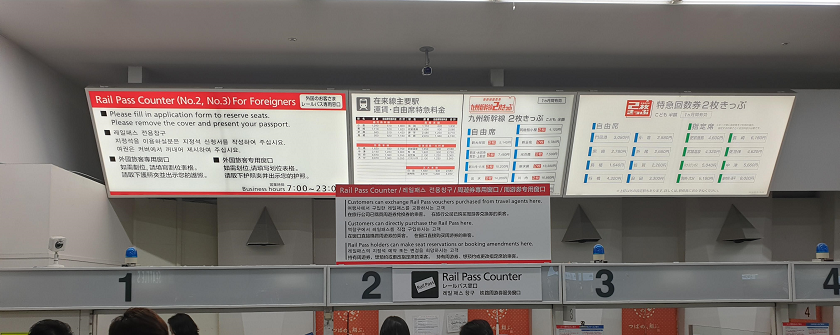
There is one main exchange point at Hakata Station — the Rail Pass Counter inside the JR Kyushu ticket office at the Central Gate, in the middle of the central station hall. Follow the signs reading "Midori no Madoguchi / Tickets" or "Rail Pass Counter" and you can't miss it. Once inside, head to kiosk numbers 1–4 — these are specifically for JR Pass and Kyushu Rail Pass users, with multilingual staff and usually much shorter queues than the general ticket windows.
The process is the same whether you're activating a Japan Rail Pass or a Kyushu Rail Pass. This includes all JR Kyushu Passes — the All Kyushu Area Pass, the Northern Kyushu Area Pass and the Southern Kyushu Pass. You can also use these same kiosks if you've already activated your pass and just want to make seat reservations.
Step-by-Step Checklist
What to bring
- Your exchange order voucher (the paper document received in the post when you bought your pass from JRPass.com)
- Your passport (showing your Temporary Visitor entry stamp from immigration)
- Optional: a written or saved itinerary, in case you'd like to make seat reservations on the same visit
Where to go in the station
4. From your arrival platform, follow signs to the Central Gate (中央口) — most JR services arrive within easy walking distance
5. Look for the Hakata Station Information Center in the central hall
6. The JR Reservation Ticket Office (Midori-no-Madoguchi) is just behind it — look for the dedicated Rail Pass Counter sign
7. Take a numbered ticket from the queue dispenser and watch the screen for your number to be called to kiosks 1–4
What to say at the counter
8. Hand over your exchange order and passport with a smile
9. In English, you can simply say: "I'd like to activate my Japan Rail Pass, please. I'd like to start on [your chosen date]." (Or in Japanese: "Japan Rail Pass o tsukaitai desu. Kaishi-bi wa [date] de onegaishimasu.")
10. If you'd also like to make seat reservations, add: "I'd like to reserve seats for the [destination] Shinkansen on [date]."
11. The staff will print your physical pass with your chosen start date and hand it back — that's it. You're set.
The whole process typically takes 5–10 minutes for activation alone, and a little longer if you're making seat reservations on the same visit.
Ticket Office Hours
The hours vary slightly by counter, so it's worth knowing which one you need.
Rail Pass Counter (dedicated, Central Gate area): 8:30–19:30 weekdays and Saturdays; 8:30–18:00 Sundays and holidays.
Central Gate Midori-no-Madoguchi: 5:40–21:15 daily.
North Gate ticket office: 4:30–00:10 daily.
Chikushi entrance / Shinkansen Central Gate: 5:30–23:00 daily.
If you arrive outside the dedicated Rail Pass Counter hours, the general Midori-no-Madoguchi counters at the other gates can also process pass exchanges — they're open very early and late, which is helpful for late-evening arrivals from the airport or ferry terminal.
Hours subject to change — verify with JR Kyushu before travel if your arrival timing is tight.
Tips for Hakata Station
- Hakata Station is much more than just a station — it's an entertainment complex with plenty of shops, restaurants, an underground mall (Hakata Ichibangai), and a rooftop garden on the top floor with great views over the city
- The Deitos food court on the Chikushi side and the Hakata Ichibangai underground food street are both excellent places to grab your first proper Hakata ramen or motsunabe right after activating
- The Japan Post office is just outside the station — handy for an international ATM or for posting a letter home
-
Coin lockers are scattered throughout the station if you want to stash your luggage and explore Fukuoka before catching your next train (see our guide to station lockers)
- If you're heading onward by Shinkansen, the Shinkansen Central Gate is on the Chikushi side of the station — plenty of signs in English will guide you
Frequently Asked Questions (FAQ)
1. What if I pick the wrong start date for my pass?
This is one of the most common worries — and the good news is that you only set your start date at the moment of exchange. The staff will ask you when you'd like to begin using the pass, and you can choose any date within one month of the exchange visit. So if you arrive today but don't want to start using the pass for a few days, just say so. Once you've left the counter with your activated pass, the start date is fixed and can't be changed, so take a quiet moment in the queue to confirm your itinerary before you reach the kiosk.
2. Will there be a long queue?
Usually no — Hakata Station's Rail Pass Counter (kiosks 1–4) is reserved for pass holders, and it tends to move faster than the general ticket windows. The busiest moments are weekday mornings (8:30–10:00) when commuters and tourists overlap, and late afternoons. If you arrive then, expect to wait perhaps 15–20 minutes; outside those windows it's usually shorter. Around lunchtime and mid-afternoon are typically the quietest times.
3. What if I don't speak Japanese?
Don't worry — the Rail Pass Counter staff at Hakata are very experienced with international visitors, and most speak good English. There are also written prompts and reservation forms available in English. If you'd like, you can simply hand over your exchange order, passport, and a written note with your start date, and the staff will take it from there. A genuine smile and a "thank you" goes a long way too.
4. Can I reserve Shinkansen seats at the same time as activating?
Yes — and we recommend it. Once your pass is active, the same staff can make seat reservations for any JR Shinkansen or limited express journey covered by your pass, all free of charge. Having your itinerary ready (which trains, which dates) speeds the process up nicely. Note: Nozomi and Mizuho services on the Sanyo Shinkansen aren't covered by the standard Japan Rail Pass, but the Kyushu Rail Passes do cover Tsubame and Sakura services on the Kyushu Shinkansen.
5. What if I arrive late at night?
The dedicated Rail Pass Counter closes at 19:30 most days, but the North Gate Midori-no-Madoguchi is open until 00:10 (yes, after midnight) and can also process pass exchanges. So even a late arrival from Fukuoka Airport or the international ferry is fine.
.png)