Deutsch
 Español
 Français
 Italiano
 Nederlands
 Português
 日本語
日本語 한국어
한국어 简体中文
简体中文 繁體中文
繁體中文


The JR Chuo Line (中央線) cuts through the heart of Tokyo in a near-straight corridor from east to west, linking Tokyo Station with Shinjuku and continuing deep into the city's western suburbs. Together with the JR Yamanote Line, it forms the backbone of JR rail travel across central Tokyo — and for visitors travelling with a Japan Rail Pass, it's one of the most useful and frequently used lines on any trip.
Whether you're commuting between Shinjuku and Tokyo Station, exploring neighbourhood streets beyond the tourist trail, or heading out on a day trip to Mt Takao, there's a very good chance the Chuo Line will be part of your daily rhythm.
Table of contents:
What is the JR Chuo line?
Train services on the JR Chuo line
Stations on the JR Chuo line in central Tokyo
Can I use the JR Pass on the Chuo line?
JR Chuo line map
Tips for travel on the JR Chuo line
What is the JR Chuo line?
The JR Chuo Line is the central rail corridor crossing Tokyo from east to west, and the fastest way to travel between Tokyo Station and Shinjuku. It plays a key role in both daily commuter traffic and tourist journeys through the city.
Within central Tokyo, the line runs between Tokyo Station and Nakano. Beyond the city limits it continues west as the Chuo Main Line, stretching over 400 km through the mountains of Nagano Prefecture before terminating at Nagoya — making it one of Japan's longest intercity rail corridors
The Chuo Line is jointly managed by two operators: JR East covers the Tokyo metropolitan section, while JR Central (JR Tokai) takes over from Takao westward. For most visitors this distinction is invisible — trains run seamlessly across both networks, and your JR Pass covers the full route.
Train services on the JR Chuo line
There are three types of service operating on the Chuo Line, and knowing the difference will save you time.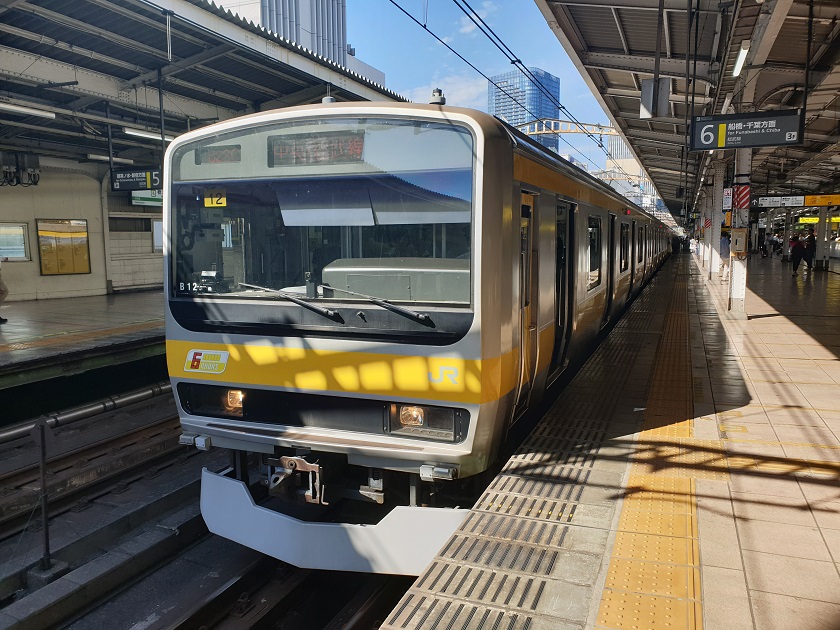
-
Rapid service (Kaisoku) — Orange-coloured trains that skip smaller stations, stopping only at the most important: Shinjuku, Yotsuya, Ochanomizu, Kanda and Tokyo Station. This is the fastest option between Shinjuku and Tokyo Station and the service most visitors will use during the day.
-
Local service (Chuo-Sobu Local) — Yellow-coloured trains that stop at every station on the route. Crucially, unlike the Rapid, the local service extends east of Ochanomizu through Akihabara and on toward Chiba. This is why you'll often see Akihabara listed as a "Chuo Line" stop — it's served by the yellow local trains, not the orange Rapid.
- Limited express services (Tokkyū) — Trains like the Azusa, Super Azusa and Kaiji run through central Tokyo and continue west toward Matsumoto and the Japanese Alps, skipping many suburban stations entirely. These require a seat reservation but are fully covered by the JR Pass, making them a great option for day trips or onward travel into Nagano Prefecture.
Stations on the JR Chuo line in central Tokyo
These are the stations within central Tokyo on the JR Chuo Line, listed west to east:
- Nakano
- Higashi-Nakano
- Okubo
- Shinjuku
- Yoyogi
- Sendagaya
- Shinanomachi
- Yotsuya
- Ichigaya
- Iidabashi
- Suidobashi
- Ochanomizu
- Kanda (Rapid service only)
-
Tokyo
Note: Akihabara is served by the yellow Chuo-Sobu Local service, which diverges eastward at Ochanomizu. The orange Rapid does not stop there.
Key neighbourhoods and what to explore
The Chuo Line passes through some of Tokyo's most distinctive neighbourhoods — several of which are well worth slowing down to explore properly.
Shinjuku is the obvious anchor and needs little introduction. The world's busiest train station by passenger volume, it's the departure point for west Tokyo shopping, Kabukicho's nightlife, the tranquil Shinjuku Gyoen garden, and onward connections across the city. Most visitors pass through Shinjuku multiple times per day.
Nakano, just a few minutes west, is home to Nakano Broadway — a sprawling, slightly ramshackle shopping complex popular with manga, anime, and vintage goods collectors. It has a more low-key atmosphere than Akihabara and is worth the short detour.
Koenji (one stop further west on the local service) has a well-earned reputation as one of Tokyo's most genuinely local neighbourhoods. Independent record shops, vintage clothing stores, live music venues, and a relaxed street culture make it feel distinctly different from the big commercial hubs — and all the better for it.
Ochanomizu sits at the junction of the Rapid and Local services and has a pleasantly specific character: the streets around the station are lined with music instrument shops, making it a Tokyo institution for musicians. Cross the river toward Kanda and you'll find one of the city's best clusters of second-hand bookshops.
Kichijoji and Mitaka, slightly further west on the outer Chuo Line, are consistently rated among Tokyo's most liveable neighbourhoods. Inokashira Park — beautiful during cherry blossom season — sits between the two, and the Ghibli Museum in Mitaka is a short walk away.
Can I use the JR Pass on the Chuo line?
Yes, the JR Chuo Line is fully covered by the Japan Rail Pass. Standard Rapid and Local services have no reserved seats, so you simply show your activated JR Pass at the ticket gate and board any train you like.
If you plan to use one of the limited express services (Azusa, Super Azusa, Kaiji) for a longer journey west toward Matsumoto or Nagoya, a seat reservation is required. Reservations on JR Pass-covered routes are free — book at any JR ticket office (Midori-no-Madoguchi) or, on some routes, via the JR East online reservation system before you travel.
JR Chuo line map
Below is a map of the JR Chuo Line in central Tokyo. For the full route across Greater Tokyo and beyond, explore our interactive JR Pass Map.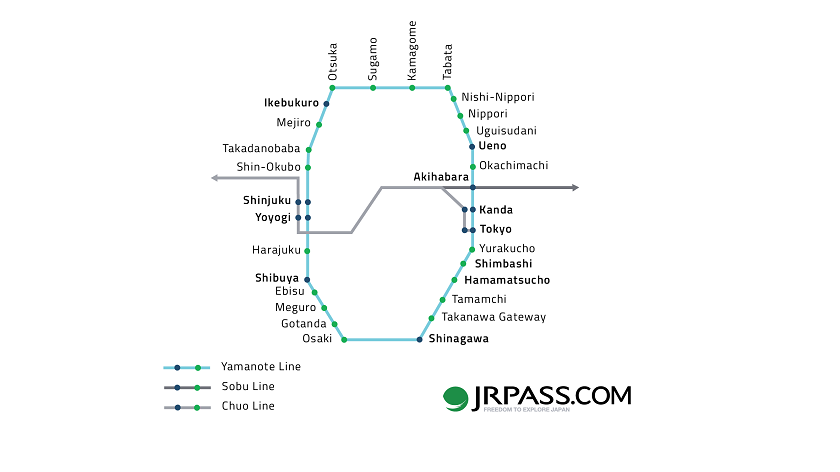
Day trips from Tokyo on the Chuo Line
One of the Chuo Line's less celebrated advantages is where it takes you beyond Tokyo. The line continues west through the suburbs and into some genuinely rewarding day trip destinations — all accessible on a single JR Pass.
Mt Takao (Takaosanguchi) is the most popular. The Chuo Line runs directly to Takaosanguchi station, the base of Mt Takao (Takao-san), one of the most visited mountains in the world. Multiple trails cater to all fitness levels, and on clear winter days the views of Mt Fuji from the summit are exceptional. The return journey from Shinjuku takes about an hour each way on the Rapid service.
Mitaka — Studio Ghibli Museum — For fans of Hayao Miyazaki's films, the Mitaka stop on the outer Chuo Line is the closest train station to the Ghibli Museum. The museum requires advance booking through specific ticket portals, but the surrounding Inokashira Park area makes the trip rewarding even if you can't get a slot.
Matsumoto and the Japanese Alps — For a longer excursion, the Azusa limited express from Shinjuku reaches Matsumoto in just under two and a half hours. Matsumoto Castle is one of Japan's finest surviving original castles, and the town sits at the gateway to the Kiso Valley and the Northern Alps. A comfortable overnight trip for JR Pass holders — and reservations are free.
Tips for travel on the JR Chuo line
- The fastest connection between Shinjuku and Tokyo Station is the Chuo Rapid (orange). It takes under 20 minutes and runs extremely frequently — every 3 to 5 minutes during the day — so there's rarely a reason to wait long.
-
Rush hour is intense, particularly inbound toward Shinjuku between 7:30–9:00 AM and outbound between 18:00–20:00. Shifting your travel by even 30 minutes either side makes a noticeable difference in comfort.
-
Late at night, the orange Rapid service doesn't run in central Tokyo — from around 10:00 PM, the yellow Local service takes over. Factor this in for evening travel plans.
-
Getting to Akihabara? Take the yellow Local train from Ochanomizu eastbound — the orange Rapid doesn't stop at Akihabara.
- The Chuo Line connects to the JR Yamanote Line at Shinjuku and Tokyo stations, and to the Tokyo Metro at several stops (Yotsuya → Marunouchi/Nanboku Line; Iidabashi → Yurakucho/Namboku/Tozai lines).
- Services run very frequently throughout the day, and the network is reliable. Delays do happen — particularly during heavy rain — but JR displays and announcements are clear.
- The Chuo Line connects to Takao-san, one of the best hiking day trips from Tokyo, covered in full by your JR Pass.
Frequently asked questions (FAQ)
1. Is the Chuo Line the same as the Sobu Line?
Not exactly. The Chuo Rapid (orange) and the Chuo-Sobu Local (yellow) share tracks between Mitaka and Ochanomizu, but diverge east of Ochanomizu. The Rapid heads toward Kanda and Tokyo Station; the Sobu Local continues through Akihabara toward Chiba. The practical difference is straightforward: orange for speed, yellow for more stops.
2. How long does the Chuo Line take from Tokyo Station to Shinjuku?
The Rapid service takes approximately 14 to 17 minutes. The Local takes a few minutes longer due to additional stops.
3. Does the Chuo Line go to Akihabara?
The yellow Chuo-Sobu Local service stops at Akihabara. The orange Rapid does not — it goes directly from Ochanomizu to Kanda and Tokyo Station without stopping at Akihabara.
4. Can I reach Mt Fuji on the Chuo Line?
Not directly, but the Chuo Line is your route toward the northern side of Mt Fuji. Take the line to Otsuki and transfer to the Fujikyuko Line for Kawaguchiko and the Fuji Five Lakes area. The JR Pass covers the Chuo Line to Otsuki; the Fujikyuko section is not included.
5. Is the Chuo Line covered by the JR Pass?
Yes — both the Rapid and Local services are fully covered, with no seat reservation needed. Limited express trains (Azusa, Super Azusa, Kaiji) require a free reservation, bookable at any JR ticket office.
.png)