Deutsch
 Español
 Français
 Italiano
 Nederlands
 Português
 日本語
日本語 한국어
한국어 简体中文
简体中文 繁體中文
繁體中文
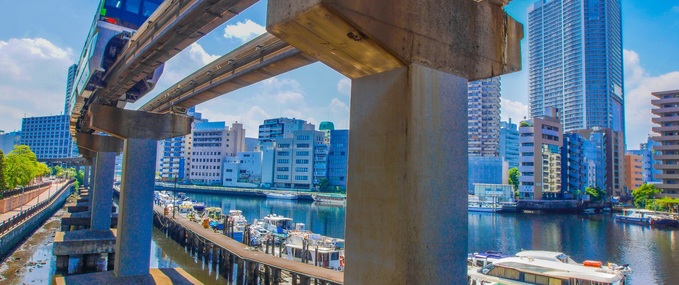


Quick Answer: The Tokyo Monorail connects Haneda Airport to Hamamatsucho Station in central Tokyo — a 17.8 km elevated ride along Tokyo Bay that takes as little as 13 minutes on the fastest Haneda Express. The monorail is fully covered by the Japan Rail Pass, so you can simply show your pass at the manned ticket gate and hop on. Trains run roughly every 3–5 minutes from 5:00 AM until about midnight, and the views over Tokyo Bay and the Rainbow Bridge make it one of the most scenic airport-to-city routes anywhere in the world.
The Tokyo Monorail runs for 17.8 km (11.1 mi) from Haneda Airport into central Tokyo, where it terminates at Hamamatsucho station. The monorail runs along Tokyo Bay for most of the line — making it one of the most scenic ways to start (or end) a trip to Tokyo.
For arrivals at Haneda Airport, the Tokyo Monorail is one of the fastest and most convenient options for reaching the city. It has direct transfer to the JR Yamanote Line at Hamamatsucho station, and it's fully covered by the Japan Rail Pass — making it the preferred way to travel for JR Pass users.
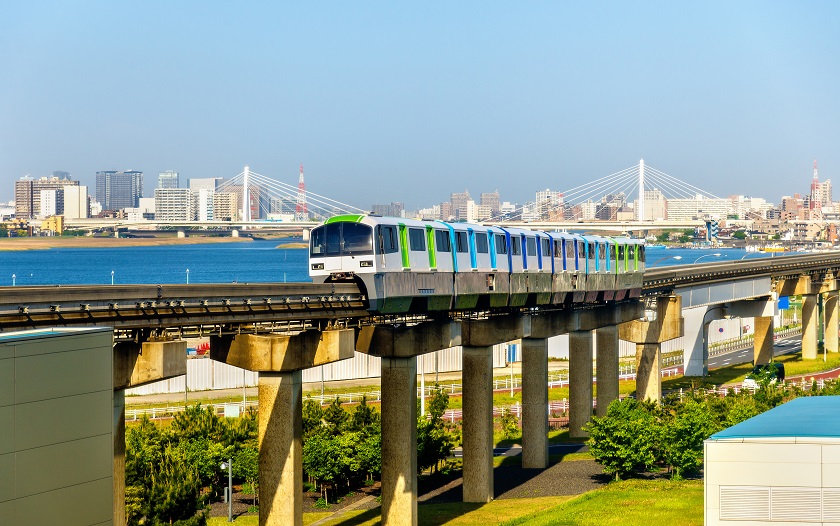
Riding the Tokyo Monorail
The Tokyo Monorail can be accessed using normal paper tickets, an IC card like Suica, or — as already mentioned — the Japan Rail Pass.
- With a paper ticket or IC card: simply tap your card or insert your ticket at the automatic gate
- With the Japan Rail Pass: go to the manned ticket gate (next to the automatic ones), show your activated pass, and walk through
- When you exit at your destination, show your JR Pass at the manned gate again to leave the station
There are no reserved seats on the monorail — it's open seating. The best views are without a doubt at the front or back of the train, where the panoramic windshield gives you a driver's-eye view of Tokyo Bay.
Types of train services
There are three service types on the Tokyo Monorail. The main difference is speed and the number of stops along the way.
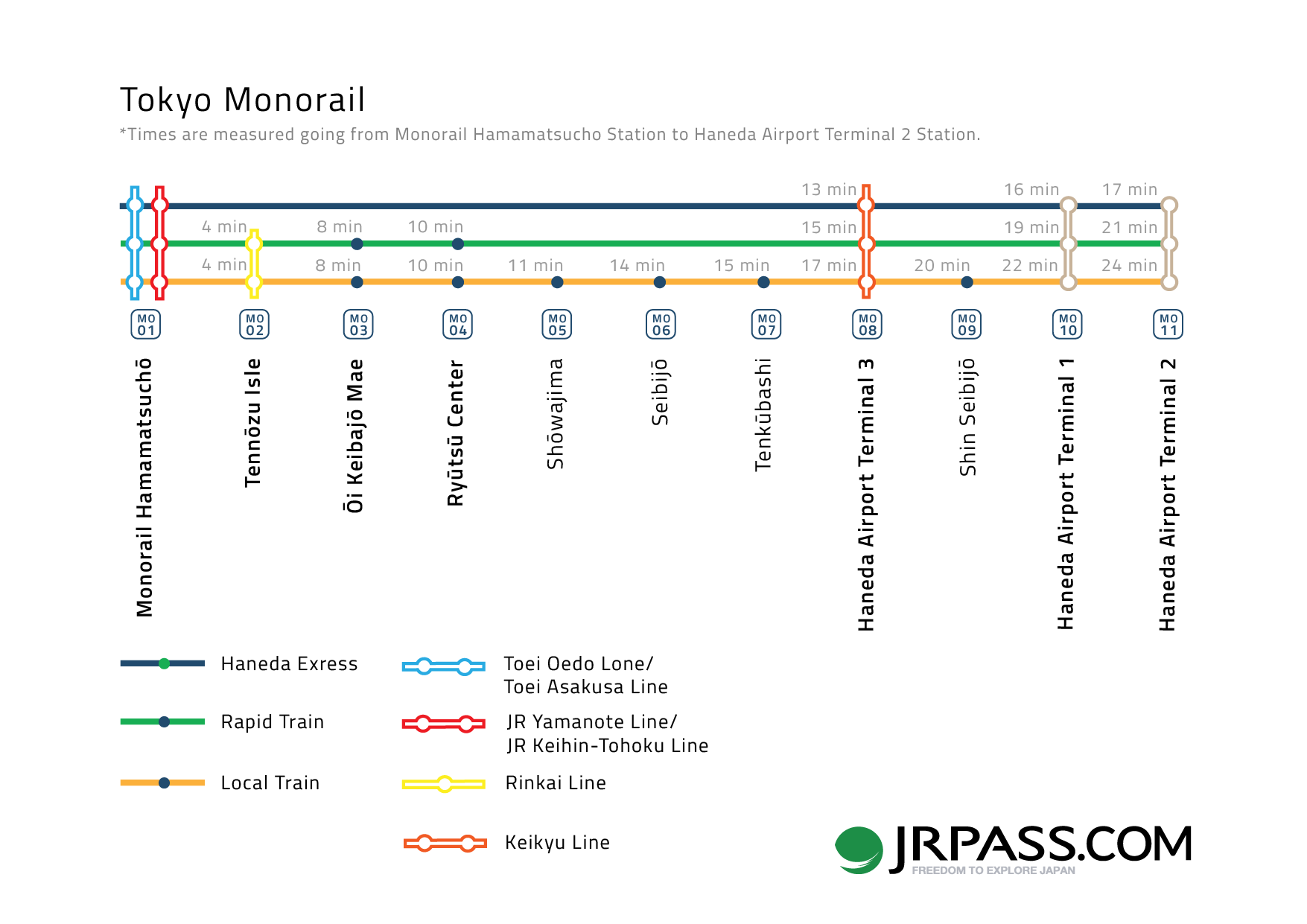
Haneda Express: The fastest service, with non-stop running between Hamamatsucho and the three Haneda Airport stations (Terminal 1, 2, and 3). Journey time ~13–14 minutes.
Section Rapid (Rapid Service): Stops at the most important stations, including Hamamatsucho, Tennozu Isle, Oi Keibajou Mae, Ryutsu Center, Tenkubashi, and the three Haneda Airport terminals. Journey time ~20 minutes.
Local Service: Stops at every station along the route. Journey time ~20–22 minutes.
The Haneda Express runs only periodically — Section Rapid and Local services are the most frequent, so don't worry if you can't catch an Express.
Tokyo Monorail Map
Here is a map with all stations on the Tokyo Monorail.
Fares, Hours and Frequency
Fare from Haneda Airport to Hamamatsucho: approximately ¥520 adult / ¥260 child (verify with current pricing — fares are subject to change). Of course, with a Japan Rail Pass the ride is free.
Operating hours: approximately 5:00 AM to midnight every day. The first train from Haneda Terminal 3 departs around 5:09 AM, and the last service from the same terminal leaves at around 11:48 PM. From Hamamatsucho heading toward the airport, the last train is around 11:45 PM.
Frequency: Trains run every 3–5 minutes during operating hours — even if you miss one, the next arrives within a few minutes. There's almost never a need to time your arrival.
If you arrive at Haneda outside the monorail's operating hours, the alternatives are taxi (expensive — typically ¥6,000–9,000 to central Tokyo) or the limousine bus (which usually runs slightly later).
See activating your JR Pass at Haneda Airport for more on early/late arrivals.
Where to Sit for the Best Views
A small Daniel-San tip that makes a big difference: head to the very front or very back of the train. Both ends have large windshields that look directly out along the elevated track, giving you a panoramic view that ordinary side windows can't match.
On the right-hand side (heading toward Hamamatsucho), you'll get views of:
-
Tokyo Bay along most of the journey
-
Rainbow Bridge as you approach central Tokyo
- The Tokyo skyline, including Tokyo Tower in the distance
On a clear day, this is genuinely one of the most beautiful airport-to-city train rides anywhere in the world — much more atmospheric than the underground Keikyu alternative.
Travelling Onwards From Hamamatsucho
Hamamatsucho Station has excellent transfer options to the rest of Tokyo and beyond:
-
JR Yamanote Line (covered by JR Pass) — the loop line connecting major Tokyo stations, including Tokyo Station, Shibuya, Shinjuku, Ikebukuro, Ueno, and Akihabara
-
JR Keihin-Tohoku Line (covered by JR Pass) — heading north toward Ueno and south toward Yokohama
- Toei Asakusa Line and Toei Oedo Line — accessible from Daimon Station, a 5-minute walk from Hamamatsucho. Useful for reaching Asakusa, Ginza, Shinjuku and Shiodome (subway is not covered by JR Pass; use Suica/PASMO)
From Tokyo Station (one Yamanote stop north of Hamamatsucho or a quick 10-minute Keihin-Tohoku ride), you can connect to the Tokaido, Tohoku, Hokuriku and other Shinkansen lines — opening up the rest of Japan with your JR Pass.
Bonus tip: Tokyo Monorail to Odaiba via Tennozu Isle
If you're heading from Haneda to Odaiba, you don't need to go all the way to Hamamatsucho. Get off at Tennozu Isle Station and transfer to the Rinkai Line (not covered by JR Pass, separate ticket required), which goes directly to Odaiba, Tokyo Big Sight, and the waterfront.
Things to See Near Hamamatsucho Station
If you've got a little time before your hotel check-in, or you're staying in the area, Hamamatsucho is genuinely well-located for sightseeing:
-
Tokyo Tower — about a 15-minute walk; one of Tokyo's most iconic landmarks
-
Zojoji Temple — about a 10-minute walk; a historic temple with Tokyo Tower as a dramatic backdrop, especially photogenic at dusk
-
Shiba Park — adjacent to Zojoji; one of Tokyo's oldest public parks
- Hamarikyu Gardens — about a 15-minute walk in the other direction; a beautiful traditional garden on Tokyo Bay with seawater ponds
It's a surprisingly rewarding pocket of Tokyo to arrive in, especially if you're not in a rush to your hotel.
Tips for Riding the Tokyo Monorail
Your JR Pass can be activated at Haneda Airport at the JR East Travel Service Center — take note of the opening hours, especially for late-night arrivals.
The monorail operates between approximately 5:00 AM and midnight every day. Outside these hours, use a taxi or limousine bus into central Tokyo.
For the best views, head to the front or back of the train — the panoramic windshield is unbeatable.
The monorail's Hamamatsucho terminus is on the second floor at Haneda Airport Terminal 3 (international arrivals) and on B1F at Terminals 1 and 2, right next to the Keikyu Line platform.
The walk from Monorail Hamamatsucho to JR Hamamatsucho Station is a few minutes through a connected concourse — well signposted.
Pocket WiFi is your friend for live train schedules — see our Pocket WiFi guide.
Frequently Asked Questions (FAQ)
1. How much does the Tokyo Monorail cost without a JR Pass?
Approximately ¥520 for adults and ¥260 for children from any Haneda Airport terminal to Hamamatsucho Station. Fares are subject to change — check the official Tokyo Monorail website for the most current pricing.
2. Can I use my Suica or PASMO on the Tokyo Monorail?
Yes — Suica, PASMO, ICOCA and all other Japanese IC cards work on the Tokyo Monorail. Just tap on at the gate and tap off at your destination; the correct fare is deducted automatically.
3. Where do I activate my JR Pass at Haneda Airport?
At the JR East Travel Service Center near the Tokyo Monorail gate at Terminal 3 (international). See our guide on activating your JR Pass at Haneda Airport for current opening hours and details.
4. Is the Tokyo Monorail or the Keikyu Line better?
If you have a Japan Rail Pass, take the Tokyo Monorail — it's free, scenic, and lands you at Hamamatsucho on the Yamanote Line. If you don't have a JR Pass and you're heading to Shinagawa, Yokohama, Asakusa or Narita Airport, the Keikyu Airport Line is a slightly cheaper option (around ¥330 to Shinagawa).
.png)