Deutsch
 Español
 Français
 Italiano
 Nederlands
 Português
 日本語
日本語 한국어
한국어 简体中文
简体中文 繁體中文
繁體中文


The Sanyo Shinkansen is the high-speed bullet-train line that runs from Shin-Osaka station to Hakata station (Fukuoka), calling at major cities such as Himeji, Okayama and Hiroshima along the way. It is one of the most important shinkansen lines and forms part of the backbone of the JR network.
At its eastern end, the Sanyo Shinkansen connects directly to the Tokaido Shinkansen at Shin-Osaka station — so many trains run straight through to and from Tokyo. At its western end, some trains continue onto the Kyushu Shinkansen at Hakata, running all the way down to Kagoshima-Chuo.
Table of contents:
A brief history of the Sanyo

The Sanyo route (or San'yōdō) was an old trade route in feudal Japan, similar to the Tokaido, running roughly 350 miles from Kyoto in the east to Shimonoseki in the west, from where travellers could continue by boat to Kyushu. The term Sanyo (山陽) means 'sunny side of the mountains' and refers to the area in the south of Honshu. Facing the Seto Inland Sea, it makes up the southern part of the Chūgoku region, including cities like Okayama, Hiroshima and Yamaguchi.
The Sanyo Shinkansen line itself opened in 1975 as Japan's second shinkansen line, extending the network west from Shin-Osaka. It runs about 554 km (roughly 340 miles) from Shin-Osaka to Hakata, with trains reaching speeds of up to 300 km/h (about 185 mph). Today it's operated by the West Japan Railway Company (JR West), and you'll typically ride modern N700-series trains (including the newest N700S) along the route.
Route and main stations
The Sanyo Shinkansen's principal stations, from east to west, are:
-
Shin-Osaka (connects to the Tokaido Shinkansen for Kyoto, Nagoya and Tokyo)
-
Shin-Kobe (for Kobe)
-
Himeji (for Himeji Castle)
-
Okayama (for Kurashiki and the connection to Shikoku)
-
Hiroshima (for the Peace Memorial Park and Miyajima)
-
Kokura (Kitakyushu)
-
Hakata (Fukuoka; connects to the Kyushu Shinkansen for Kumamoto and Kagoshima)
Train services on the Sanyo Shinkansen
Five train types run on the line. The main thing to know is that Nozomi and Mizuho are the two fastest services (and the two that require a supplement for JR Pass holders — see below), while Hikari, Sakura and Kodama are fully covered by the JR Pass.
Nozomi
The fastest service, running through from Tokyo (on the Tokaido Shinkansen) to Hakata. On the Sanyo section it stops only at the major hubs — typically Shin-Osaka, Shin-Kobe, Okayama, Hiroshima, Kokura and Hakata — and covers Shin-Osaka to Hakata in about 2.5 hours.
Mizuho
The fastest service between Shin-Osaka and Kagoshima-Chuo, running through onto the Kyushu Shinkansen. There are only a few round trips per day, mainly mornings and evenings. On the Sanyo section it stops at much the same major hubs as the Nozomi.
Hikari
The Hikari uses the same trains as the Nozomi but makes a few more stops, and it's fully covered by the JR Pass. On the Sanyo Shinkansen, most through Hikari services run only as far west as Okayama, calling at all stations between Shin-Osaka and Okayama.
Sakura
The Sakura runs between Shin-Osaka and Kagoshima-Chuo (through onto the Kyushu Shinkansen), making a few more stops than the Mizuho — including Shin-Kobe, Himeji and Kumamoto — and is fully covered by the JR Pass. It's an excellent, comfortable option for travelling west of Okayama towards Hiroshima and Kyushu without paying a supplement.
Kodama
The Kodama stops at every station along the Sanyo Shinkansen and works as a shuttle service between smaller and larger stations. It's the slowest option — around five hours from Shin-Osaka to Hakata — but useful for reaching smaller cities.
Note: for a special experience, the Sanyo line has also been home to themed trains such as the Hello Kitty Shinkansen. Themed services and their schedules change over time, so check the latest before planning around one.
Can I use the JR Pass on the Sanyo Shinkansen?
Importantly, this has changed in recent years: since October 2023, JR Pass holders can also ride the Nozomi and Mizuho on the Sanyo (and Tokaido and Kyushu) Shinkansen by paying a supplementary fare — so these trains are no longer off-limits, they simply cost a little extra. (Previously the pass couldn't be used on them at all.) You can reserve seats free of charge, whichever service you choose.
To work out fares and whether a pass is worthwhile for your itinerary, use our JR Fare Calculator, and check the official JR West site for the latest ticket prices.

Regional passes on the Sanyo Shinkansen
As the line is operated by JR West, most JR-West regional passes are valid on the Sanyo Shinkansen — notably the Sanyo-San'in Area Pass and the Kansai-Hiroshima Area Pass. A key advantage: unlike the nationwide JR Pass, these regional passes cover the Nozomi and Mizuho with no supplement, so if you plan to ride the fastest trains a lot within western Japan, a regional pass can be excellent value. See all options on our Regional Passes page.
Green Class on the Sanyo Shinkansen
Green Class (first class) carriages are available on almost all Sanyo Shinkansen trains, except for a few Kodama services. Green Class uses a 2×2 seating layout, while ordinary cars use 3×2, so Green seats offer extra space, comfort and recline. Green carriages are generally quieter too — a good way to escape the crowds on busy days. To travel in Green Class you'll need a Green JR Pass (or the appropriate ticket).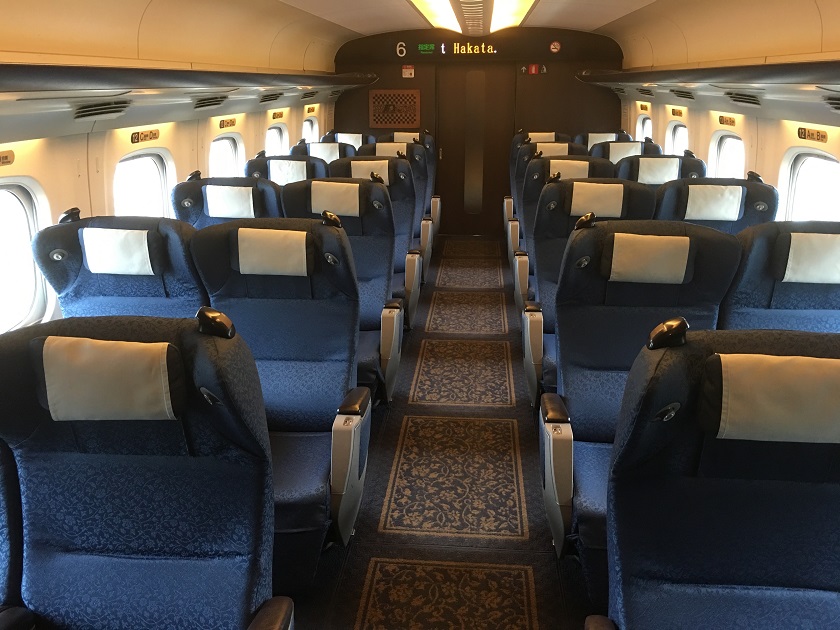
WiFi on the Sanyo Shinkansen
Free onboard WiFi is now available on the Sanyo Shinkansen, so you can stay connected between Shin-Osaka and Hakata. Connections on any train can be variable, though, especially through the many tunnels on this route. If you'd like a fast, reliable connection for all your devices throughout your trip, we recommend a Pocket WiFi device.
FAQs
1. Is the Sanyo Shinkansen covered by the JR Pass?
Yes. Hikari, Sakura and Kodama services are fully covered. Since October 2023, JR Pass holders can also ride the faster Nozomi and Mizuho by paying a supplementary fare. Seat reservations are free with the pass.
2. What trains run on the Sanyo Shinkansen?
Five services: Nozomi and Mizuho (fastest), Hikari and Sakura (semi-fast) and Kodama (all stops). Mizuho and Sakura run through onto the Kyushu Shinkansen towards Kagoshima.
3. How long does the Sanyo Shinkansen take?
The line is about 554 km long. A Nozomi covers Shin-Osaka to Hakata in roughly 2.5 hours, while an all-stops Kodama takes around 5 hours. Exact times vary by service.
4. What are the main stations on the Sanyo Shinkansen?
Shin-Osaka, Shin-Kobe, Himeji, Okayama, Hiroshima, Kokura and Hakata, plus smaller stations served by Kodama trains.
5. Can I ride the Nozomi or Mizuho with a JR Pass?
Yes, with a supplementary fare (since October 2023). Alternatively, several JR West regional passes — such as the Sanyo-San'in Area Pass — cover the Nozomi and Mizuho with no supplement.
.png)