English
 Español
 Français
 Italiano
 Nederlands
 Português
 日本語
 한국어
 简体中文
 繁體中文


The Philosopher path (哲学の道 – Tetsugaku no michi) is a scenic walkway following a small water canal in the Higashi-yama district in the north-east of Kyoto. Just two kilometres long and lined with more than 500 cherry trees, it is one of the most peaceful ways to spend a morning in Kyoto, wandering between temples, tiny cafes and the quiet sound of running water.
Table of contents:
Exploring Philosopher path
When is the best time to visit the Philosopher path?
Getting to the Philosopher path
Tips for visiting
Exploring Philosopher path
Starting at Nanzenji Temple, the path follows a small canal line with more than 500 cherry blossom trees and passes a number of temples and shrines including Eikan-do (Zenrin-ji), Otoyo Shrine and Honen-in, before ending around Ginkakuji, the Silver Pavilion. The path is picturesque from beginning to end and especially so during the Sakura season. Here is why each stop is worth your time:
Nanzenji: a large Zen temple at the southern end of the route, a good place to begin, with a striking brick aqueduct that is part of the same canal system.
Eikan-do: one of Kyoto's most popular autumn colour spots, so well worth a detour in November.
Honen-in: a quiet, peaceful temple just off the path, where you can step away from the crowds.
Ginkakuji: the Silver Pavilion, a UNESCO-listed Zen temple that was once a retirement villa, and the natural finish line for your walk.
The name Philosopher path comes from it being the walking route of Nishida Kitarō, one of the most significant and influential Japanese philosophers, who is often associated with the Kyoto School along with fellow philosopher Tanabe Hajime. He used the path often to walk from his dwelling to Kyoto university, and was often found somewhere along the path in contemplation and meditation.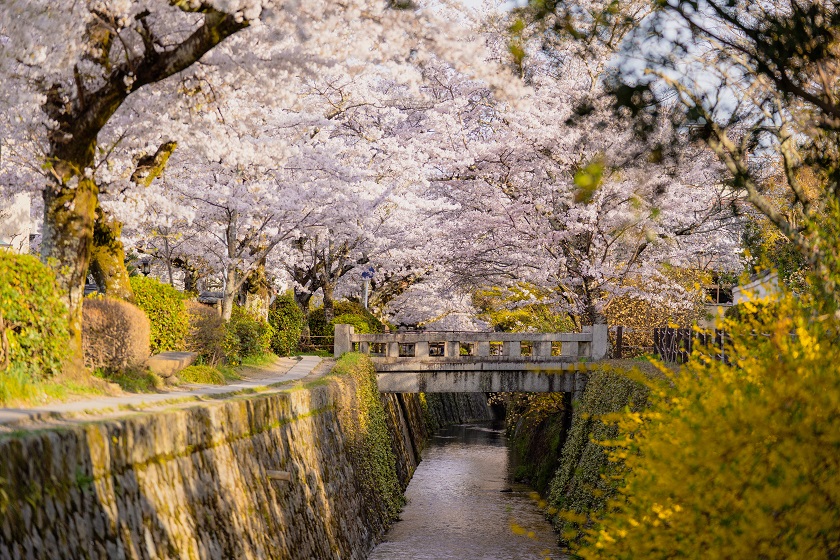
These days the path is a popular destination for locals and tourists alike, due to the many varieties of coffee shops, boutique shops and small temples. Walking the path itself takes about half an hour, it is possible to spend many hours exploring the area. There is a series of beautiful photo opportunities near the northern part of the path, overlooking Daimonji mountain and surrounding forest.
The path follows part of the Lake Biwa Canal system, which was built in the late 19th century to bring water to Kyoto, and which also fed Japan's first hydroelectric power plant. As part of the canal, there's an appealing aqueduct near Nanzenji.
When is the best time to visit the Philosopher path?
The Philosopher path can be visited year round, and there are no closing hours. The best time to visit the Philosopher path is during the Sakura Season, when all the trees turn a beautiful pink, or during autumn when the surrounding area turns into an impressive palette of reds and browns. Many of the cherry trees were first planted along the canal in the 1920s by the painter Hashimoto Kansetsu and his wife, and some locals still call them "Kansetsu-zakura".
The path can be pretty busy during the day with tourists, for the best experience it is recommended to come either early or a little before dark when most tours are finished. The path has a completely different, but romantic atmosphere after dark and is worth exploring at night as well.
Getting to the Philosopher path
Using the Kyoto metro, the best station to get out at is called Keage station, on the Tozai line. This puts you at the southern end of the path, close to Nanzenji, so you can walk the whole route up to Ginkakuji.
There is unfortunately no JR Station nearby, so your Japan Rail Pass won't take you all the way. The Kyoto subway and city buses are not covered by the pass, so you'll pay for them separately.
How to get to the Philosopher path from Kyoto Station
There are a few simple ways to reach the path from Kyoto Station:
By subway: take the Karasuma Line to Karasuma-Oike, change to the Tozai Line and get off at Keage. The ride takes around 15 minutes, followed by a short walk of roughly 15 minutes to the southern end of the path.
By bus: city buses 5 and 17 run from Kyoto Station to the Ginkakuji-michi stop at the northern end of the path, taking around 40 minutes. From there it's a short walk to the path and Ginkakuji itself, which means you can walk the route from north to south.
Subway plus bus: Kyoto's official tourist site suggests taking the Karasuma Line to Imadegawa Station and changing to bus 203 to Ginkakuji-michi, which avoids the busiest downtown stretches.
Bus routes and numbers can change and the buses are often crowded, particularly in cherry blossom and autumn leaf seasons, so check the current timetable before you set off.
Tips for visiting
- The wider area of Higashiyama is home to many of Kyoto’s best attractions, it’s easy to combine the Philosopher path with other sights in the district. Walking the path itself takes around 30 minutes, but allow a half-day if you want to visit the temples along the way.
FAQs
1. How do I get to the Philosopher's Path from Kyoto Station?
The easiest way is by subway: take the Karasuma Line to Karasuma-Oike, change to the Tozai Line and get off at Keage, then walk. You can also take city bus 5 or 17 from Kyoto Station to Ginkakuji-michi, which takes around 40 minutes. There is no JR station nearby, and the JR Pass doesn't cover the subway or city buses.
2. How long does it take to walk the Philosopher's Path?
The path is about 2 km long and takes around 30 minutes to walk without stops. Allow a half-day if you want to visit Nanzenji, Eikan-do, Honen-in and Ginkakuji along the way.
3. When is the best time to visit the Philosopher's Path?
Early April is the best time for cherry blossoms, and late November is best for autumn colours. The path is busy during the day, so for the best experience go early in the morning or shortly before dusk.
4. Is the Philosopher's Path free?
Yes, the path itself is free and open at all times. The temples along the way set their own opening hours and charge their own admission fees.
5. Why is it called the Philosopher's Path?
It is named after the philosopher Nishida Kitarō, who often walked along the canal to Kyoto University, thinking and meditating as he went.