Deutsch
 Español
 Français
 Italiano
 Nederlands
 Português
 日本語
日本語 한국어
한국어 简体中文
简体中文 繁體中文
繁體中文
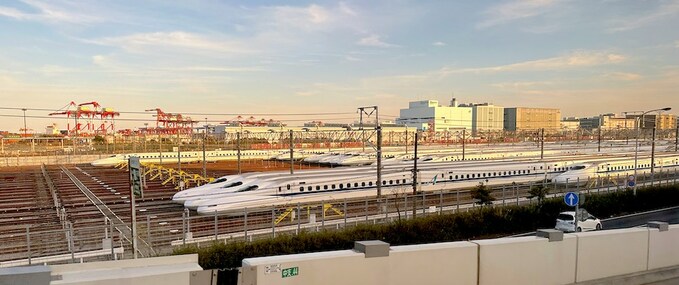


The Shinkansen is Japan's network of high-speed "bullet trains," running up to 320 km/h across the country from Hokkaido in the north to Kyushu in the south. Trains come in three service types per line — fast, semi-fast and all-stops — and three seat classes: Ordinary, Green, and premium GranClass. The Japan Rail Pass covers almost the entire network (including the Nozomi and Mizuho, with a supplement, since October 2023). Seat reservations are free with the pass, all trains are now non-smoking, and large suitcases may need a free oversized-baggage reservation. It's fast, punctual, spotless, and one of the great travel experiences on earth.
Find out everything you need to know in our comprehensive guide to travelling on Japan's iconic Shinkansen bullet trains.
Japan's bullet trains are world-famous, and rightfully so. Fast, futuristic, efficient, safe and comfortable, the Shinkansen are arguably the most celebrated trains in the world. More than a means of transport, they're a must-see attraction in their own right — riding one is as essential a Japan experience as seeing Mount Fuji or the cherry blossoms. And with the Japan Rail Pass, they let you reach destinations right across this spectacular country on a single ticket.
In this complete guide, we'll tell you everything you need to know: the lines, the train types, the seats, how to reserve, the luggage rules, what it's like on board, and the most cost-effective way to ride.
What is the Shinkansen?
The word Shinkansen (新幹線) translates literally as "new trunk line" — and refers both to the trains and to the dedicated high-speed tracks they run on. In everyday English, "Shinkansen" and "bullet train" are used interchangeably.
Japan changed rail travel forever when the first Shinkansen departed Tokyo in 1964, just in time for the Tokyo Olympics. Six decades later, the network stretches from Hokkaido in the north to Kagoshima in the south, with trains running at up to 320 km/h (199 mph).
What truly sets the Shinkansen apart isn't just speed — it's the combination of speed with legendary punctuality (average delays are measured in seconds), an extraordinary safety record (no passenger fatalities from derailment or collision in its entire history of high-speed operation), and a level of cleanliness and comfort that has to be experienced to be believed. Curious why modern bullet trains have those long, pointed noses? See our guide on why Shinkansen no longer look like a bullet.

A Short History of the Shinkansen
Japan’s modern-day history as a world-leader and innovator in rail travel began after the end of the Second World War, but it was the 1964 Tokyo Olympics that proved the catalyst for Japan’s bullet train revolution with the opening of the Shinkansen – the world’s first high-speed train - to coincide with the games. This ‘bullet train’ became synonymous with Japan and ushered in a golden age for the country’s trains over the course of the next decade. Today, the Shinkansen carries more than 150 million passengers every year. Japan has continued to build on its legacy with innovations and achievements, too.
Ever since their launch, Japan’s Shinkansen have been famous for their record-breaking speed, their efficiency, and their safety. The iconic design has continued to evolve from the 1960s, and more recently, it has been streamlined into different, more aerodynamic nose shapes, including a duck-billed design, to overcome a noise issue created by sonic booms while going through tunnels. One of the newest Shinkansen models is the N700S ‘Supreme’ Shinkansen, the latest 700 series operated by JR Central, which runs on the Tokaido and Sanyo Shinkansen lines. The train can reach an impressive new top speed of 362 km/h (225mp/h).
Shinkansen Travel Tips
If you’re visiting Japan for the first time, using the country’s exceptional rail network might initially feel a little daunting, but thankfully, it’s much easier than you might expect. At the same time, it’s still important to do your research before you travel and we’re here to help with this with our selection of the best general Shinkansen travel tips, such as:
The Shinkansen Lines
The Shinkansen network spans the country with several lines, each radiating to a different region. The main ones:
-
Tokaido Shinkansen — Tokyo–Nagoya–Kyoto–Osaka. The busiest and most popular line with tourists, linking Japan's three biggest destinations
-
Sanyo Shinkansen — Osaka–Kobe–Okayama–Hiroshima–Hakata (Fukuoka). Often run together with the Tokaido line
-
Kyushu Shinkansen — Hakata–Kumamoto–Kagoshima, down the island of Kyushu
-
Nishi-Kyushu (Nagasaki) Shinkansen — the newest line, opened September 2022, connecting Takeo-Onsen and Nagasaki (see our Nagasaki Shinkansen guide)
-
Tohoku Shinkansen — Tokyo–Sendai–Morioka–Shin-Aomori. The longest line, home to the fastest train, the Hayabusa
-
Hokkaido Shinkansen — continues from Shin-Aomori under the sea to Shin-Hakodate-Hokuto (extending to Sapporo around 2030–31)
-
Joetsu Shinkansen — Tokyo–Niigata
-
Hokuriku Shinkansen — Tokyo–Nagano–Kanazawa–Tsuruga (extended to Tsuruga in March 2024)
- Akita & Yamagata "mini-Shinkansen" — branch lines off the Tohoku Shinkansen serving Akita (Komachi) and Yamagata (Tsubasa)
For a fuller picture of the whole rail network, see our Visitor's Guide to Trains and Railways in Japan.
Seat Types: Ordinary, Green and GranClass
Shinkansen trains typically offer three classes:
-
Ordinary Car — comfortable, spacious standard seating (usually 2+3 across). Included with a standard Japan Rail Pass
-
Green Car — Japan's equivalent of first class, with wider 2+2 seating and more legroom. Included with a Green Japan Rail Pass
- GranClass — the ultra-premium top tier (found on some Tohoku, Hokkaido, Hokuriku and Joetsu trains), with luxurious 1+2 leather seats, attendant service and refreshments.
Note: GranClass is not included free with any JR Pass — you'll pay the full GranClass fare on top, even with a Green Pass

Tickets and Seat Reservations
Even with a Japan Rail Pass, it's worth understanding reservations:
- Reserved seats guarantee you a specific seat. With a JR Pass, reservations are free — make them at any JR ticket office (Midori-no-Madoguchi), at a reservation machine, or in some cases via the online reservation systems
- Non-reserved seats are first-come, first-served on most trains. But note: some trains — including the Nozomi, Mizuho, Hayabusa, Hayate and Komachi — are reserved-seat only, with no non-reserved option, so you must reserve
- During peak periods (cherry blossom, Golden Week, Obon, New Year), reserve early — trains fill up
Luggage Rules
If you're travelling with a large suitcase, there's one rule worth knowing. On the Tokaido, Sanyo, Kyushu and Nishi-Kyushu Shinkansen lines, any bag with total dimensions (width + height + depth) over 160 cm (up to a maximum of 250 cm) requires a free reservation for a "seat with oversized baggage area." These are seats in the last row of a car, with dedicated storage space behind them.
- The reservation is free, but mandatory — boarding with oversized baggage without one can incur a ¥1,000 penalty
- There are baggage-sizing gauges at affected stations so you can check
- Exempt items (no reservation needed regardless of size): strollers, wheelchairs, bicycles (in covers), sports equipment like skis and surfboards, and musical instruments
- The other Shinkansen lines (Tohoku, Hokkaido, Joetsu, Hokuriku, etc.) don't currently enforce this rule, though storage space is still limited
For most travellers with a normal carry-on or medium suitcase (under 160 cm total), there's nothing to worry about — just use the overhead racks or the space behind the last row. To travel hands-free, consider Japan's excellent luggage forwarding services (takuhaibin), which can send your bags hotel-to-hotel.

On Board: Etiquette, Food and More
Riding the Shinkansen is a pleasure, and a few notes will help you fit right in:
-
All Shinkansen are now completely non-smoking. As of March 2024, the last smoking rooms (on the Tokaido, Sanyo and Kyushu lines) were removed, so the entire network is smoke-free. Designated smoking areas exist only in some stations
-
Keep phone calls to the deck. Set your phone to silent ("manner mode") and step out to the area between carriages for calls
-
Eat an ekiben! Buying a station bento (ekiben) to enjoy on board is a beloved Japanese tradition — Tokyo Station's selection is legendary. Note that in-train trolley/cart sales have ended on the Tokaido Shinkansen, so buy food and drinks on the platform or in the station before boarding (platform vending machines are available)
-
Recline considerately and return your seat upright before your stop
-
Tidy up — take your rubbish with you or use the bins between cars
- Watch the scenery — keep an eye out the right-hand side (heading west on the Tokaido) for a glimpse of Mount Fuji!

The Future: Maglev and New Trains
The Shinkansen keeps evolving. JR East unveiled its new E10 series in March 2025 (with test runs from 2027, replacing older E2 and E5 trains by around 2030), and the experimental Alpha-X testbed has been tested at up to 400 km/h.
But the truly revolutionary future is the Chuo Shinkansen, a magnetic-levitation (maglev) line under construction between Tokyo and Nagoya, with a planned extension to Osaka. Japan's maglev test train holds the world rail speed record of 603 km/h (375 mph), set in 2015, and the line is designed to run at 500 km/h in service — which would reduce Tokyo–Nagoya to around 40 minutes. For more, see our guide to Shinkansen and maglev trains.
Top Five Shinkansen Facts
Japan’s amazing Shinkansen trains are famous for much more than just their iconic looks. Here are our top five Shinkansen facts:
- In its first year, the Shinkansen transported 11 million passengers! Today, the Shinkansen carries more than 150 million passengers every single year.
- I am speed! Bullet trains are famous for their speed and continue to break records. The Alpha X train Shinkansen is one of the fastest trains in Japan and can make the journey from Tokyo to Sapporo in just three hours - a route that even recently took seven hours. The Class E956 “Alpha-X” Shinkansen is a 10-car experimental bullet train operated by JR-East on the Tohoku Shinkansen line, which is capable of speeds of up to 400 km/h. It is the latest in speed and safety, but there are many more futuristic, pioneering new trains in development.
- Despite being the fastest, Japan’s trains are also incredibly safe, with no passenger accidents in almost 50 years of continuous service.
Shinkansen trains feature special automatic air brakes for earthquakes and the latest trains, such as N700s supreme shinkansen, have full active suspension and an all new ATC braking system for safety stops during earthquakes and other emergencies.
The Alpha X, meanwhile, also features the most innovative safety technology, including air brakes on the roof and magnetic plates near the rails to slow down, in addition to the conventional braking system.
- Shinkansen are so efficient that the average delay is just 12 seconds!
- Bullet trains are eco-friendly! A recent study showed that Shinkansen produce 92% less carbon emissions per seat than an aeroplane.
Bonus Recommendations
Naturally, we have even more on the subject of Japan’s world-leading train network on the JR Pass blog. Here are a few bonus recommendations for you to read at your leisure to further enhance your Japan railway knowledge.
- For those new to travelling by train in Japan, we’ve put together a comprehensive Visitors Guide to Trains and Railways in Japan which offers an indispensable and detailed introduction to the country’s rail network.
- Did you know that Japan has more than 30 different types of trainspotters? Read our guide to Trainspotting in Japan for more.
- From the busiest train station in the world to the best train food you’ll ever have, find out more in our Top Ten Amazing Japanese Train Facts.
- Japan’s trains don’t just connect its amazing cities, they’re also a gateway to the country’s stunning coastlines, untouched rural countryside, and mountain hideaways. Read our guides to Japan’s Coastlines by Train and Japan’s Best Rural Train Journeys for more.
Ready to Ride?
The Shinkansen is, quite simply, one of the most extraordinary travel experiences in the world — fast, flawless, comfortable, and a joy from the moment the doors hiss shut and the platform begins to slide away. With your Japan Rail Pass covering the network, an ekiben on your tray table, and Mount Fuji about to appear out the window, you're in for a treat.
Reserve your seat, grab your bento, and enjoy the ride. There's nothing quite like it. Have a wonderful trip!