Deutsch
 Español
 Français
 Italiano
 Nederlands
 Português
 日本語
日本語 한국어
한국어 简体中文
简体中文 繁體中文
繁體中文


Have you ever wondered what it would feel like to step back into the Edo period—not metaphorically, but physically, as if you had somehow crossed into another century? Tokyo is a city where the past often appears in fragments, whether it’s a shrine wedged between office towers, a stone wall behind a vending machine, or a narrow alley that escaped redevelopment. But rarely does it present history as a whole. That’s precisely why the Fukagawa Edo Museum stands out. It doesn’t simply display Edo-period artifacts, but recreates an entire neighborhood and invites you to walk through it as if you belonged there.
The museum is also filling a gap right now, as the Tokyo Metropolitan Edo-Tokyo Museum has been closed for major renovations since 2022 and is has only just reopened earlier this year. In the meantime, smaller institutions have quietly stepped into that role, drawing curious visitors to places they might otherwise overlook. Chief among them is the Fukagawa Edo Museum. Small but meticulously crafted, it succeeds in doing what scale alone cannot—making the past feel alive. Welcome to our latest JRPass guide.

Special update: You can now buy single rail tickets for Japan’s Golden Route on JRPass.com - single fares, one-way, fully digital, including the Shinkansen 'bullet' train.
The Edo Period in Context
To appreciate what this museum does so well, you have to step back and consider the era it brings to life.
Spanning from 1603 to 1868, the Edo period (also sometimes called the Tokugawa period) was when Japan was governed by the Tokugawa shogunate, a military government headquartered in Edo—the former name for Tokyo. It began after Tokugawa Ieyasu, a powerful daimyo (feudal lord), emerged victorious at the Battle of Sekigahara in 1600. His opponents were loyal to the regime established by Toyotomi Hideyoshi, the military ruler who had unified most of Japan after more than a century of conflict. Although the country had largely been pacified before Sekigahara, this battle decisively settled the question of who would control the nation’s political future. And, three years later, Ieyasu was appointed shogun (supreme military commander), formalizing a new system of rule that would shape Japan for more than two and a half centuries.

Under the Tokugawa shogunate, Japan experienced an unusual combination of stability and control. Society was structured around a formal hierarchy of classes—samurai, farmers, artisans, and merchants—though groups such as outcasts and itinerant workers did exist outside this system. What’s more, daimyo were required to spend alternate years in Edo, under a policy known as sankin-kotai that was designed to prevent rebellion and ensure loyalty to the central government. With large-scale warfare largely absent, cities expanded rapidly. Edo itself grew into one of the world’s largest urban centers, its population rising into the hundreds of thousands and eventually surpassing one million around 1720. This growth reshaped not just the skyline but the rhythm of daily life as food distribution networks expanded, artisan industries flourished, and entertainment districts became centers of a newly emerging urban culture.
The Edo period is often associated with isolation, largely because of a foreign policy adopted by the shogunal government, or bakufu, in the 1630s known as sakoku, meaning “closed country.” Under this system, diplomatic relations and trade with other nations were tightly restricted, most foreign nationals were barred from entering Japan, and ordinary Japanese were prohibited from leaving. Yet this did not lead to stagnation. On the contrary, woodblock prints, kabuki theater, popular fiction, and intricate crafts flourished, reflecting a society increasingly oriented toward urban consumption and leisure. Everyday aesthetics, from textile patterns to shop signs and household objects, were refined to a level that still shapes Japanese design today.

Japan, however, could not remain isolated forever. In 1853, the arrival of an American naval officer, Commodore Matthew Perry, and his fleet of “black ships” in Edo Bay forced the country to confront Western powers, accelerating political tensions that would ultimately culminate in the Meiji Restoration. When Perry returned the following year, negotiations in Yokohama led to the opening of treaty ports, marking the beginning of Japan’s formal engagement with the outside world. The shogunate soon collapsed, imperial rule was restored in 1868, and Edo was renamed Tokyo. Within a generation, the wooden city began transforming into a modern capital of brick, railways, and industry.
The Fukagawa Edo Museum showcases the city just before that transformation—a late Edo neighborhood frozen in time, as it stood on the brink of becoming Tokyo.
Visiting the Museum
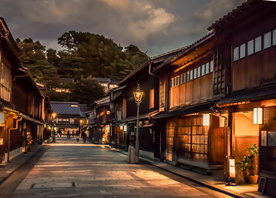
Located in Koto City, a special ward of Tokyo, the Fukagawa Edo Museum centers on a full-scale reconstruction of a neighborhood in Fukagawa-Sagamachi, or Saga Town, as it appeared in the late Edo period, specifically during the Tempo era of the 1830s and early 1840s. This was a time within the Edo period when urban culture in the shogunate’s capital was highly developed, and districts like Saga Town reflected the patterns of everyday city life. The neighborhood lay within the broader Fukagawa area, a low-lying district shaped by canals, warehouses, and densely packed working-class streets. Closely tied to shipping and trade, it essentially functioned as a waterfront district that helped sustain the enormous city of Edo, which depended heavily on waterways to transport food, fuel, and other essential goods.

All of this is faithfully recreated in the museum’s permanent exhibition. After descending the stairs, visitors step into a bustling market street lined with wholesalers selling lumber, rice, vegetables, and dried sardines. Following the road toward the Sumida River, you pass a small Inari shrine. Dedicated to Inari Okami, a deity associated with foxes, rice, prosperity, and commerce, such shrines were commonly found in merchant districts and offered spiritual reassurance in a world where fire, flood, or financial loss could undo a household overnight.
Along the river stand large warehouses, reminders of the waterways that once sustained Edo’s economy. Turning back into town through narrow alleys reveals rows of typical homes, as well as shared neighborhood facilities such as a communal well, toilet, and refuse area used by residents in their daily lives. Nothing is miniaturized, and that single design choice transforms the experience. Instead of looking down at a model, you move through the streets yourself. The buildings rise to full height, and most can be entered after removing your shoes, their interiors furnished with period tools and household items: cooking implements near hearths, goods arranged for sale, and bedding stored compactly to conserve space. It quickly becomes clear how carefully people had to negotiate daily life in a dense wooden city where privacy was limited and proximity unavoidable.

As you continue exploring, you’ll also come across a woodworker’s house filled with carpentry tools, a riverside boatmen’s inn where travelers once lodged, and a teahouse displaying replicas of foods popular in the Edo period. Nearby stands a fire watchtower overlooking Saga Town. Such towers were vital in Edo, where tightly packed wooden buildings and open flames made fires frequent and often devastating, earning them the nickname “flowers of Edo.” From these towers, watchmen scanned the skyline for smoke and raised alarms to alert residents.
The experience is intentionally immersive. Lighting gradually shifts to suggest the passage of time from morning to evening, while ambient sounds—voices, footsteps, and the faint creak of wood—create the impression that the neighborhood’s residents have only stepped away for a moment.

Just beyond the recreated streets, though still within the main exhibition hall, a smaller adjoining gallery shifts the focus to the yearly festivals and rituals that shaped life in Edo. Here, displays introduce visitors to traditional observances such as Tsukimi, the autumn moon-viewing festival, when people gather to admire the moon, while offering rice dumplings (dango) and Japanese pampas grass (susuki) in thanks for a successful season. Together, these displays reveal how the calendar itself shaped experience in Edo, marking time through celebration as much as through routine.
Because the museum concentrates on just one neighborhood, rather than the whole country, its storytelling feels personal. It suggests that history is not only the story of rulers and state policies but also of carpenters, vendors, tenants, and ordinary people. In that sense, the museum complements larger institutions rather than competing with them. Where grand museums present sweeping narratives, the Fukagawa Edo Museum lets you experience history at street level.
The Fukagawa Edo Museum is open Thursday through Monday from 9:30 a.m. to 5:00 p.m. It is typically closed on the second and fourth Mondays of each month, unless those dates fall on public holidays, so it’s best to check the schedule before planning your visit.

How to Get There
Getting to the museum is easy, making it a convenient addition to a half-day outing. The nearest stop is Kiyosumi-shirakawa Station, served by both the Hanzomon Line and the Oedo Line.
From Shibuya or Tokyo Station, take the Hanzomon Line directly and walk about six minutes after arriving.
Travelers coming from Shinjuku can ride the Oedo Line straight there.
The surrounding area offers plenty to explore as well, including the tranquil grounds of Kiyosumi Gardens, Kiba Park, and thought-provoking exhibitions at the Museum of Contemporary Art Tokyo. This part of Koto City is also known for its relaxed atmosphere and growing cafe scene, making it easy to turn a museum visit into a leisurely half- or full-day outing.

Pro Tips
In many ways, the Fukagawa Edo Museum is both a destination and a departure point. From Tokyo, travelers can continue exploring Japan’s past by rail with a Japan Rail Pass, or choose a Regional Pass for shorter regional trips.
And wherever the road leads, Pocket Wi-Fi keeps essential information—from directions to weather forecasts—readily accessible.
First-time visitors to Japan might also appreciate Meet & Greet services, which can definitely help make things easier while you’re still getting your bearings in a city as big as Tokyo.
FAQs for Visiting the Fukagawa-Edo Museum
Q: How much is admission, and can you pay by card?
A: Admission to the Fukagawa Edo Museum is 400 yen for adults or 50 yen for high school students and those younger, but visitors should note that payment is cash only.
Q: How long should I plan to spend there?
A: Most visitors spend about 60–90 minutes exploring the main exhibition, though history enthusiasts may want closer to two hours.
Q: Is it suitable for visitors who don’t speak Japanese?
A: Yes. While not every display is fully translated, there is enough English signage—and visual storytelling—that non-Japanese speakers can easily understand and enjoy the museum. There are also English-speaking guides in the main exhibition.
Q: Does the museum have coin lockers?
A: Yes. Coin lockers are available in the lobby and can accommodate smaller items such as handbags, totes, or even backpacks, but are not designed for large suitcases. They require a 100 yen refundable deposit (cash only), so it’s worth carrying some coins if you plan to store anything during your visit.
Q: Does the Fukagawa Edo Museum have a gift shop?
A: Yes. The museum has a small shop where visitors can purchase souvenirs inspired by Edo-period culture and daily life. Items often include replicas of historic maps, postcards, and stationery. You can also find merchandise featuring Kotomi-chan, the mascot of Koto City, making it a fun place to pick up a locally themed souvenir.
Q: Is the museum accessible for visitors with mobility needs?
A: Yes. The building is equipped with an elevator, wheelchair-accessible restrooms, tenji blocks (tactile paving) for visually impaired visitors, and an underground parking facility. The reconstructed streetscape is fully indoors and relatively easy to navigate compared with outdoor historical sites.