Deutsch
 Español
 Français
 Italiano
 Nederlands
 Português
 日本語
日本語 한국어
한국어 简体中文
简体中文 繁體中文
繁體中文


Quick Answer: The Hokuriku Shinkansen is a high-speed bullet train line running from Tokyo through Nagano and Kanazawa to Tsuruga in Fukui Prefecture — a 470 km route jointly operated by JR East and JR West. It originally opened in 1997 as the "Nagano Shinkansen," was extended to Kanazawa in 2015, and reached Tsuruga in March 2024. Four train services run on the line: the fast Kagayaki, the all-line Hakutaka, the Toyama–Tsuruga Tsurugi shuttle, and the Tokyo–Nagano Asama. The whole line is covered by the nationwide Japan Rail Pass, and the Hokuriku Arch Pass is a popular regional alternative.
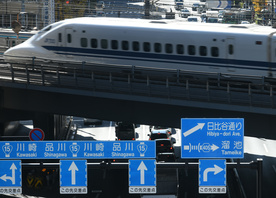
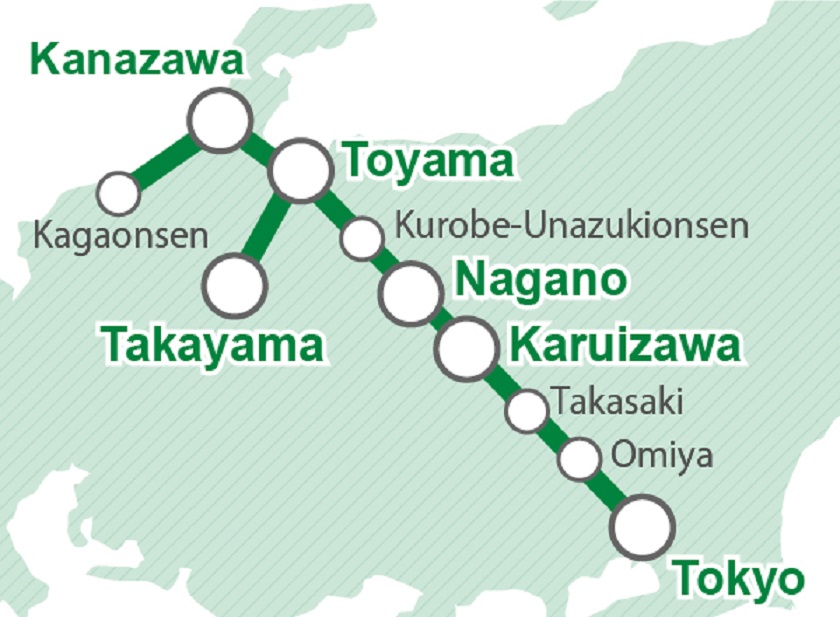
The Nagano & Hokuriku Shinkansen is a high-speed bullet rail line that stretches from Tokyo all the way to Tsuruga in Fukui Prefecture. Major stops along the way include Karuizawa, Nagano, Toyama, and Kanazawa. The line is popular for visiting Kanazawa, the Japanese Alps, the Hokuriku region, and as a gateway toward Takayama. It is jointly operated by JR East and JR West.
The History Behind the Name
First opened on 1 October 1997, the line originally connected Tokyo to Nagano — which is where the original name comes from, the Nagano Shinkansen (長野新幹線). The timing was no accident: the line opened just in time for the 1998 Nagano Winter Olympics.
The line was later extended to Kanazawa, opening on 14 March 2015, and the name was changed to Hokuriku Shinkansen (北陸新幹線), named after the Hokuriku region the line travels through. Most recently, the line was extended again — from Kanazawa to Tsuruga in Fukui Prefecture — opening on 16 March 2024. The line now runs 470.6 km with 24 stations.
Though the line was officially always the Hokuriku Shinkansen, JR East preferred the name "Nagano Shinkansen" before the Kanazawa extension, mainly to avoid confusing its customers. While the name "Nagano Shinkansen" can still occasionally be seen at places like Tokyo Station, it has mostly fallen out of use.
Train services on the Hokuriku Shinkansen
There are four train services on the Hokuriku Shinkansen:
Kagayaki Shinkansen
The fastest service on the line, running between Tokyo and Tsuruga (via Kanazawa). It stops only at the most important stations — Ueno, Omiya, Nagano, Toyama, Kanazawa — completing Tokyo to Kanazawa in around 2.5 hours. The Kagayaki is one of the few Shinkansen with reserved seats only. Seat reservations can be made for free at any JR station with a JR Pass.
Hakutaka Shinkansen
The standard all-line service, stops at most stations along the full route from Tokyo to Tsuruga. The Hakutaka has both reserved and non-reserved seating, making it the most flexible option.
Tsurugi Shinkansen
A shuttle service running between Toyama and Tsuruga, stopping at every station along the way. Since the 2024 extension, the Tsurugi connects with limited express trains (Thunderbird, Shirasagi) at Tsuruga for onward travel toward Kyoto and Osaka.
Asama Shinkansen
A shuttle service running between Tokyo and Nagano, stopping at most stations. Named after Mount Asama, the active volcano near Karuizawa.
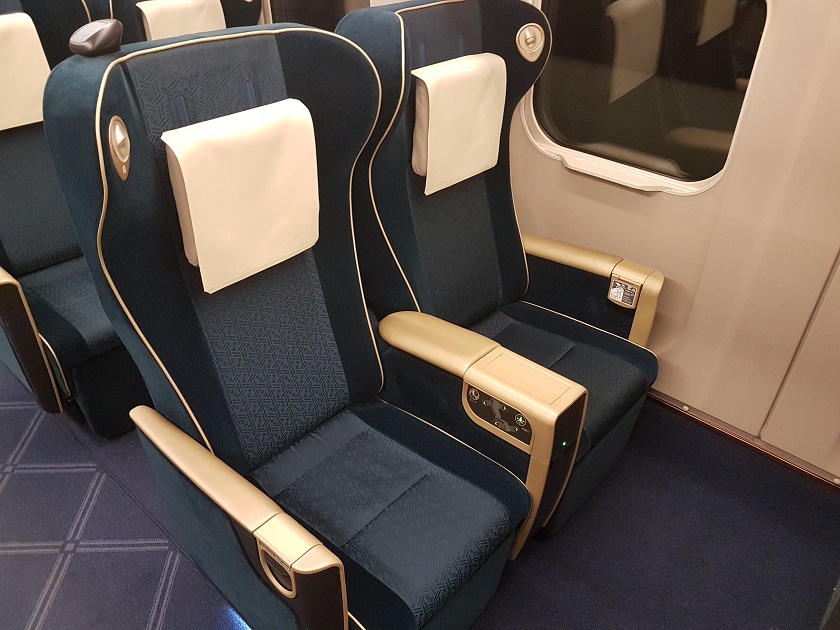
All four services use the elegant E7/W7 series Shinkansen trains, jointly developed by JR East and JR West for the Hokuriku line.
Riding the Line With a Rail Pass
The Hokuriku Shinkansen is fully covered by the nationwide Japan Rail Pass — including the Kagayaki, Hakutaka, Tsurugi, and Asama services. If you have a JR Pass, you can simply make a free seat reservation and ride.
There are also two excellent regional passes for this line:
Hokuriku Arch Pass
The Hokuriku Arch Pass is a regional pass designed for the "arch"-shaped route between Tokyo and Osaka via the Hokuriku region — letting you avoid the busy Tokaido Shinkansen and travel the scenic way instead.
-
Price: ¥35,000 for adults / ¥17,500 for children (6–11), valid for 7 consecutive days
-
Covers: the Hokuriku Shinkansen from Tokyo to Tsuruga, JR lines in the Tokyo and Osaka areas, the Narita Express, the Tokyo Monorail, and limited express trains (Thunderbird, Haruka) connecting Tsuruga to Kyoto and Osaka
-
Does not cover: the Tokaido or Sanyo Shinkansen
- See our full guide: Hokuriku Arch Pass: Your Guide to Japan's New Golden Route
JR East Pass (Nagano, Niigata area)
If your trip focuses on Nagano and Niigata rather than continuing to Osaka, the JR East Pass (Nagano, Niigata area) covers the Hokuriku Shinkansen between Tokyo and Joetsumyoko (via Nagano), plus the Joetsu and Tohoku Shinkansen within the area. It's valid for 5 days within a 14-day window.
For a full comparison of which pass suits your itinerary, see our Expert Guide to Regional Passes.
Destinations Along the Line
The Hokuriku Shinkansen connects a wonderful string of destinations:
-
Karuizawa — a chic highland resort town about 1 hour from Tokyo; popular for cycling, outlet shopping, and cool summer escapes
-
Nagano — home to the magnificent Zenkoji Temple and a gateway to the Snow Monkey Park at Jigokudani (see below)
-
Iiyama — gateway to the Nozawa Onsen and Madarao ski areas
-
Toyama — known for its glassmaking, the dramatic Kurobe Alpine Route, and beautiful Toyama Bay
-
Kanazawa — one of Japan's cultural treasures: Kenrokuen Garden, the Nagamachi samurai district, the geisha teahouses of Higashi Chaya, and the 21st Century Museum of Contemporary Art
-
Fukui — famous for the Fukui Prefectural Dinosaur Museum (one of the best dinosaur museums in the world) and the Zen temple Eiheiji
-
Tsuruga — the line's western terminus and the transfer point for limited express trains to Kyoto and Osaka
WiFi on the Hokuriku Shinkansen
JR East and JR West have started the introduction of free WiFi on the Hokuriku Shinkansen since 2018. However, the service is currently limited only to the fastest services along the line, and full introduction is likely to be completed by 2022.
Should you wish to make use of unlimited WiFi with a guaranteed connection, then we recommend using a Pocket WiFi in Japan, which can be connected to any WiFi-capable device.
A Beautiful Way to Travel Central Japan
The Hokuriku Shinkansen is one of Japan's most rewarding rail journeys — a fast, comfortable line connecting Tokyo to the temples of Nagano, the gardens of Kanazawa, the mountains of Toyama, and the dinosaurs of Fukui. Whether you're using a nationwide Japan Rail Pass or the regional Hokuriku Arch Pass, it opens up a side of Japan that many visitors miss.
If you have any questions about planning a Hokuriku itinerary, drop by the JRPass Forum — I check in regularly and there's always someone friendly with experience to share. Have a wonderful trip!
Frequently Asked Questions (FAQ)
1. Is the Hokuriku Shinkansen the same as the Nagano Shinkansen?
Yes, they're the same line. It opened in 1997 as the "Nagano Shinkansen" when it only ran as far as Nagano. After the line was extended to Kanazawa in 2015, the name officially became the Hokuriku Shinkansen. You may still occasionally see "Nagano Shinkansen" signage, but the line is now universally called the Hokuriku Shinkansen.
2. Where does the Hokuriku Shinkansen go?
The line runs from Tokyo through Omiya, Karuizawa, Nagano, Toyama and Kanazawa, terminating at Tsuruga in Fukui Prefecture. The Kanazawa-to-Tsuruga extension opened in March 2024. At Tsuruga, you can transfer to limited express trains for Kyoto and Osaka.
3. What's the difference between the Kagayaki and Hakutaka?
The Kagayaki is the fastest service, stopping only at major stations and offering reserved seats only. The Hakutaka is the standard all-line service, stopping at more stations and offering both reserved and non-reserved seating. Both are covered by the Japan Rail Pass and use the same E7/W7 trains.
4. How much does the Hokuriku Arch Pass cost?
As of March 2026, the Hokuriku Arch Pass costs ¥35,000 for adults and ¥17,500 for children (ages 6–11), valid for 7 consecutive days. The price increased from ¥30,000 on 14 March 2026, when the coverage area was also expanded to include the Chuo Line route toward Matsumoto and Hakuba.
5. Is the Hokuriku Shinkansen covered by the Japan Rail Pass?
Yes, the nationwide Japan Rail Pass fully covers all four Hokuriku Shinkansen services (Kagayaki, Hakutaka, Tsurugi, and Asama). Just make a free seat reservation at any JR ticket office before boarding, especially for the reserved-seat-only Kagayaki.
6. How long does it take from Tokyo to Kanazawa on the Hokuriku Shinkansen?
On the fastest Kagayaki service, Tokyo to Kanazawa takes about 2 hours 30 minutes. The Hakutaka takes around 3 hours, as it makes more stops along the way.
7. Can I take the Hokuriku Shinkansen from Tokyo to Osaka?
Not directly, the Hokuriku Shinkansen terminates at Tsuruga. From Tsuruga, you transfer to a limited express train (Thunderbird) to reach Kyoto and Osaka. The Hokuriku Arch Pass is designed for exactly this Tokyo–Osaka via Hokuriku route.