Deutsch
 Español
 Français
 Italiano
 Nederlands
 Português
 日本語
日本語 한국어
한국어 简体中文
简体中文 繁體中文
繁體中文


To celebrate Japan's 4-0 victory against Tunisia today in the 2026 World Cup in the United States, we're taking a special look at why the country's national team play in their famous Samurai blue colors.
Ask anyone what colour Japan plays in and the answer is immediate: blue. A deep, unmistakable blue that has been on the national team’s shirt for the better part of a century and earned the team one of football’s most evocative nicknames. Then look at the Japanese flag, the Hinomaru, the Circle of the Sun, and there is no blue anywhere. A red disc on a white background. That is it.
The question of why Japan wears blue has no single definitive answer on record, and that is part of what makes it interesting. What we do know is that the colour dates back at least to 1930, that a specific match in 1936 turned it into a national superstition, and that it eventually became the foundation for one of football’s most recognised nicknames. Behind the colour is over ninety years of Japanese football history: amateur beginnings, a professional revolution, one of the most devastating near-misses in World Cup history, eight consecutive tournament appearances, and a crest featuring a mythological three-legged crow from ancient Shinto mythology. Discover more as Japan's World Cup journey continues.
Special update: You can now buy single rail tickets for Japan’s Golden Route on JRPass.com - single fares, one-way, fully digital, including the bullet train.
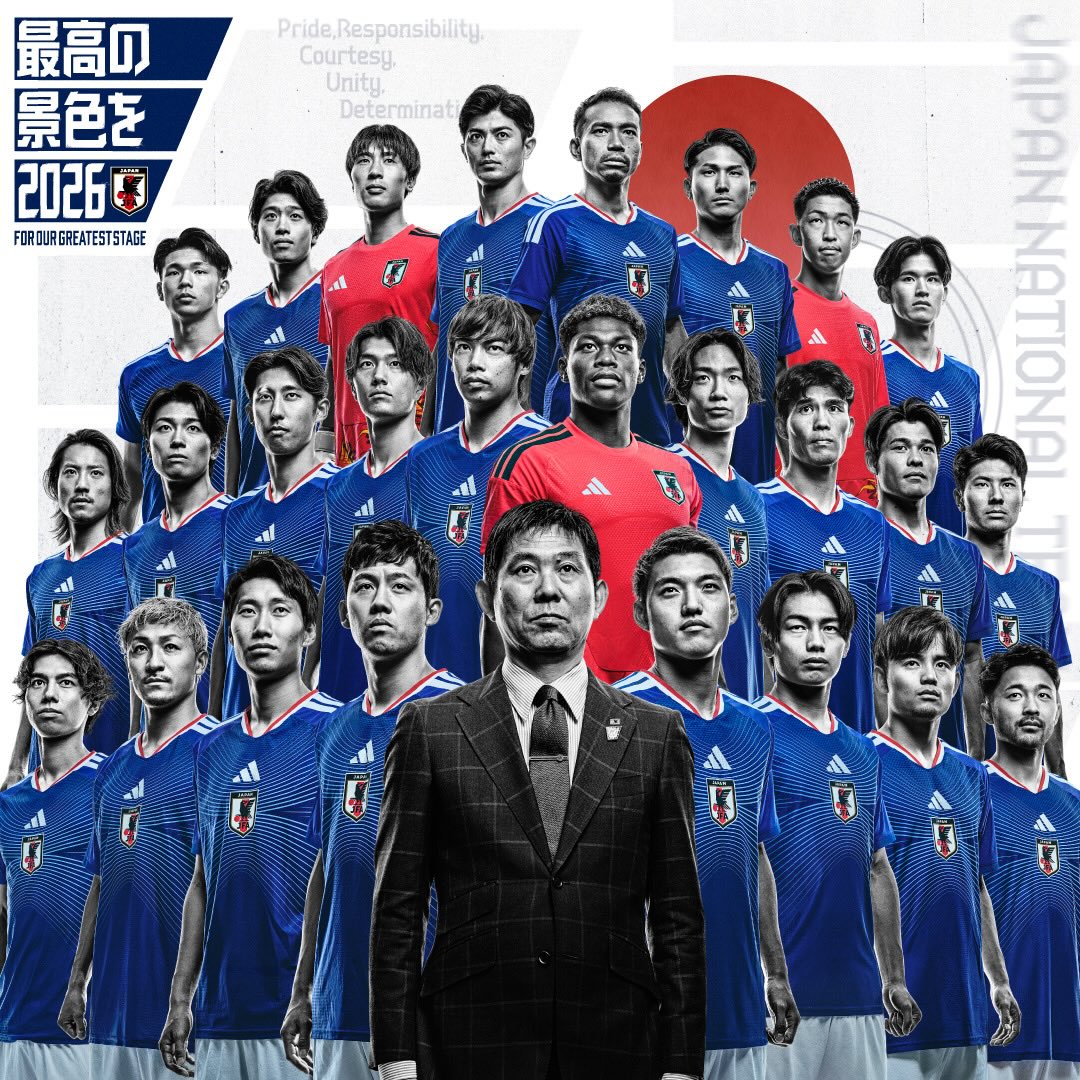
Samurai Blue: Quick Facts
Official nickname | Samurai Blue (サムライブルー)
Nickname officially adopted | October 19, 2009 (by Japan Football Association)
Jersey colour first used | 1930 Far Eastern Championship Games
Most cited colour origin | 1936 Berlin Olympics — 3–2 victory over Sweden in blue kit
JFA crest | Yatagarasu (three-legged crow) — adopted 1931
J.League founded | May 15, 1993 (ten founding clubs)
First World Cup | 1998, France
Consecutive World Cups | Eight (1998–2026)
Best World Cup result | Round of 16 (2002, 2010, 2018, 2022)
2026 World Cup group | Group F — Netherlands, Senegal, Sweden
Why Does Japan Wear Blue? The Full Story
Japan’s flag, the Hinomaru, is a red disc on a white background. It contains no blue. The Japan Football Association’s official position is that the true origin of the blue jersey is undocumented and not definitively known. What the historical record does establish is a sequence of events across the 1930s that explains how blue became permanent, even if it does not explain who chose it first and why.
Blue first appeared at the 1930 Far Eastern Championship Games, where Japan shared the title. Between 1930 and 1992 the kit changed several times, including a switch to red and white under coach Kenzo Yokoyama (1988–1992) to match the flag, a period that saw Japan miss both the 1990 World Cup and 1992 Olympics. After those failures, blue was restored, and every home kit since 1992 has been blue.
The colour's status as a good-luck superstition traces to a single match: the 1936 Berlin Olympics, where a Japan team built mainly from Tokyo Imperial University students (whose own colour was light blue) came back from 2–0 down to beat Sweden 3–2, the first Olympic or World Cup win by an Asian team, remembered as the "Miracle of Berlin." Blue became associated with that victory and the association stuck, even though Japan lost their next match to Italy.
A third layer connects the jersey to older Japanese culture: for the 2018 World Cup, the JFA chose a deep indigo called kachi-iro, explicitly citing its historical link to samurai and its phonetic resemblance to the word for "victory" (kachi). Whether this connection played a role in 1930 isn't documented, but the JFA deliberately built it into the 2018 kit's identity.
Where “Samurai Blue” Comes From
The nickname “Samurai Blue” draws on both halves of its name in ways that are more layered than they first appear. The blue is the jersey colour established since the 1930s. The samurai is Japan’s ancient warrior class, whose identity, rooted in the code of Bushido, values of honour, discipline, courage, and loyalty has become one of Japan’s most internationally recognised cultural symbols.
The nickname had been in colloquial use for decades before it was formalised. Ahead of the 2006 World Cup in Germany, the Japan Football Association held a public vote to officially designate the national team’s nickname. Japanese fans chose “Samurai Blue” overwhelmingly from among the options presented. The nickname was officially adopted on October 19, 2009. The women’s team, by contrast, is known as “Nadeshiko Japan”, named after the nadeshiko, a delicate pink flower that symbolises resilience alongside grace.
The association between the blue kit, the samurai identity, and the kachi-iro colour history gives the nickname a coherence that is not accidental. Whether or not it was designed that way from the beginning, it became a genuinely resonant piece of national sporting identity.
The Three-Legged Crow: Japan’s Extraordinary Crest
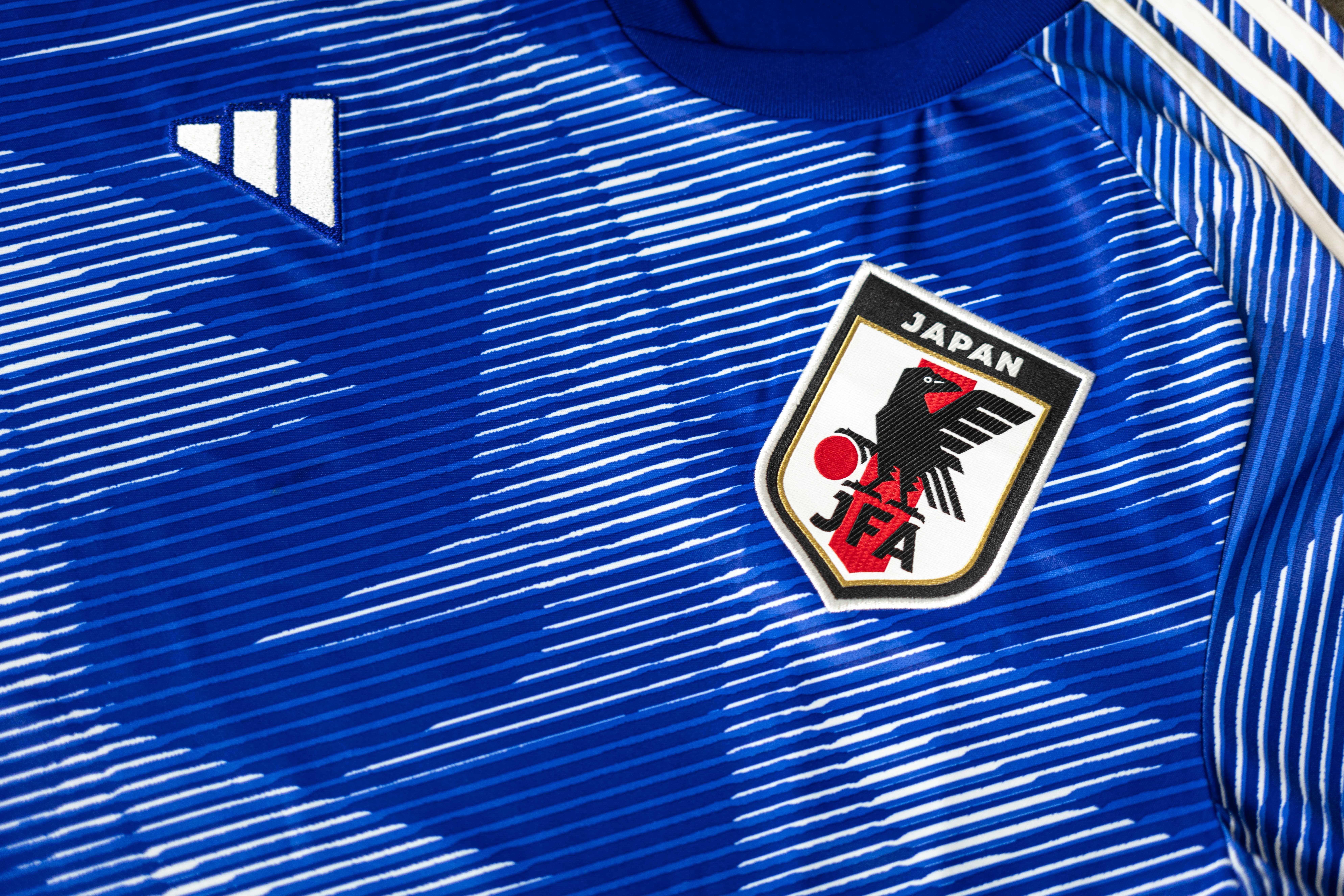
The crest on a Japan national team shirt features a crow with three legs, the Yatagarasu, a mythological creature that has appeared on every shirt since the JFA adopted it as its official emblem in 1931, five years before the famous "Miracle of Berlin."
In Japanese mythology, the Yatagarasu appears in the ancient chronicles Kojiki and Nihon Shoki as a divine messenger sent by the sun goddess Amaterasu to guide the legendary first Emperor Jimmu through treacherous mountains, helping him found the imperial lineage. The three legs, however, come from a separate tradition: ancient Chinese mythology, where a three-legged bird was said to live inside the sun. This concept merged with the Yatagarasu in Japan, appearing in 7th-century Kitora Tomb murals and on a cabinet at Horyuji Temple. In Shinto tradition, the three legs represent heaven, earth, and humanity, and the bird is still worshipped at the Kumano Taisha shrines in Wakayama.
The JFA's emblem was designed in 1931 by Jitsuzo Hinago, based on ideas from founding member Tairei Uchino, a scholar of Chinese classics drawn to the sun-bird tradition. The choice also honoured Kakunosuke Nakamura, a Kumano-born football pioneer who first translated the rules of the sport into Japanese and died at 27 before seeing its growth in Japan.
The symbolism is deliberate: just as the Yatagarasu guided Emperor Jimmu to found a nation, the JFA placed it on the jersey to guide the ball to the goal, a divine navigator worn on the chest of every player since 1931.
.jpeg)
Japan at the 2026 World Cup
The 2026 FIFA World Cup is co-hosted by the United States, Canada, and Mexico, the first World Cup held across three countries. The expanded format brings 48 teams to the tournament, up from 32. Japan qualified for the 2026 tournament, continuing their run of consecutive World Cup appearances to eight.
Japan are placed in Group F for the 2026 tournament. Their group stage matches, in Tokyo time, are scheduled as follows:
June 15, 05:00 (JST) [June 14, 5pm, CST] | Japan vs Netherlands
June 21, 13:00 (JST) [June 21, 1am, CST] | Japan vs Tunisia
June 26, 08:00 (JST) [ June, 25, 5pm, CST] | Japan vs Sweden
And if your World Cup plans extend beyond Japan, the 2026 tournament is split across the United States, Canada, and Mexico, with 48 teams playing across 16 host cities, and getting between matches is its own logistical puzzle.
We've built a free route planner to help with exactly that: pick your team, and it maps out every group stage journey, comparing flights, rail, driving, and taxi options side by side, with realistic city-to-city timings.
Whether you're following Japan from Dallas to Monterrey, or planning your own route around a different team entirely, it's a quick way to see your options before you book anything.
Try it at jrpass.com/worldcup-route-planner.

1) Choose the country you have tickets for.
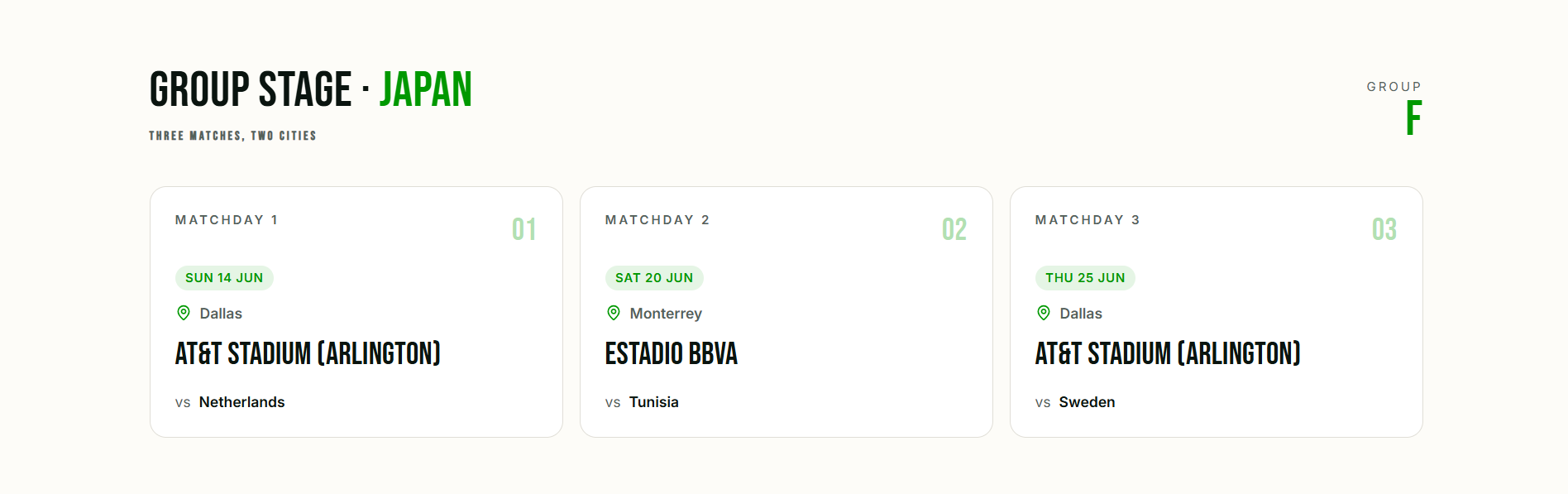
2) Check the cities they're playing on.

3) Plan the best way to travel around in between matched.
Why Japanese Football Culture Is Worth Understanding
For international visitors to Japan in 2026, whether arriving for the World Cup or simply travelling the country in the months surrounding it, understanding the Samurai Blue gives Japanese culture a new entry point.
The J.League operates year-round, with matches in cities across Japan that are accessible by Shinkansen. Watching a J.League match as a foreign visitor is one of the more immediately accessible local cultural experiences available in the country: affordable tickets, high-quality football, passionate but exceptionally welcoming crowds, and stadium food that is significantly better than anywhere in Europe. The league currently has 60 clubs across three divisions.
The Yatagarasu on the jersey connects directly to the Kumano Taisha shrines in Wakayama Prefecture, one of the most significant pilgrimage destinations in Japan and a UNESCO World Heritage Site. Understanding the football crest provides a reason to visit a pilgrimage route that most international visitors never find.
And the story of Japanese footbal is a compressed version of Japan’s postwar economic and cultural trajectory: rapid professionalisation, relentless improvement, global ambition, and a specific determination not to let the Agony of Doha happen again.
How to Experience Japanese Football as a Visitor
- Attend a J.League match: Tickets are available on the J.League official website and at club websites. Most stadiums are accessible by train from city centres. Crowds are welcoming to international visitors and stadium food is a genuine reason to go.
- Travel by Shinkansen between cities: The J.League has clubs in Sapporo, Sendai, Tokyo, Yokohama, Nagoya, Osaka, Kobe, Hiroshima, and Fukuoka, among others. A JR Pass makes following the league across multiple cities genuinely affordable.
- Visit the Kumano Taisha Shrines in Wakayama: The spiritual home of the Yatagarasu is a UNESCO World Heritage site and one of Japan’s most rewarding pilgrimage destinations. The ancient Kumano Kodo pilgrimage routes run through the mountains to the shrines. The connection to the national football crest is a starting point, but the place earns its own visit.
- Watch World Cup matches in local establishments: Japan’s izakaya (pub-restaurant) culture makes watching football in a local setting a genuinely social experience. Screens go up for major matches and the atmosphere at any Japan game during the 2026 tournament will be significant.
- Learn the Yatagarasu story before you visit Kumano: Knowing why there is a three-legged crow on the football shirt makes the shrines considerably more resonant. The Yatagarasu stone at Kumano Nachi Taisha is considered the resting place of the divine crow itself.